Progress Update. 23rd April 2026
Sam Thompson; BOC/EGI Case Student
Six months into my PhD and things are really starting to take shape. For my first couple of terms at Oxford—Michaelmas and Hilary as we call them here—one of my primary focuses has been brushing up on the literature surrounding avian vision, obstacle avoidance and flock behaviour. It is a fascinating field and much of our understanding of it is a result of work conducted right here in Oxford; work led by academics such as Professors Graham Taylor, Dora Biro and Tim Guilford. With trials in our state-of-the-art flight lab at the John Krebs Field Station due to commence imminently using our population of homing pigeons, other jobs on my to-do list have included finalising experimental protocols, sorting ethical permissions, and conducting personality assays on my avian test subjects. As will become clear further down the line, the social dynamics of flocks form a principle underpinning of my research project. Knowing which birds rule the roost—or rather, the loft—will be paramount in understanding how flocks operate and the challenges that individual birds face when trying to negotiate obstacles as part of a group.
So, how exactly do you determine a pigeon’s personality? Essentially, it involves putting the bird in a room under various contexts and seeing what it does. A pigeon’s personality is a construct of many different facets of its behaviours, and these ‘various contexts’ aim to test some of these facets. For instance, neophobia—the unwillingness to approach or engage with something new or unknown—can be gauged by testing a bird’s wariness of novel objects placed in its environment. The term ‘novel’ allows for a good deal of creative scope—something which I am delighted to say I have fully embraced. I hope that the example [see Picture 1] of one of my novel objects provides sufficient demonstration! For those wondering how I managed to sculpt such a masterpiece, I’m afraid that’s a trade secret. Before you move to pooh-pooh my approach, please know that the use of novel objects, such as this bizarre piece, is a tried and tested method of quantifying avian personality. It is well cited in the scientific literature and is a topic with which my supervisor, Dr Steve Portugal, has a wealth of experience. Rest assured, the project is in safe hands.
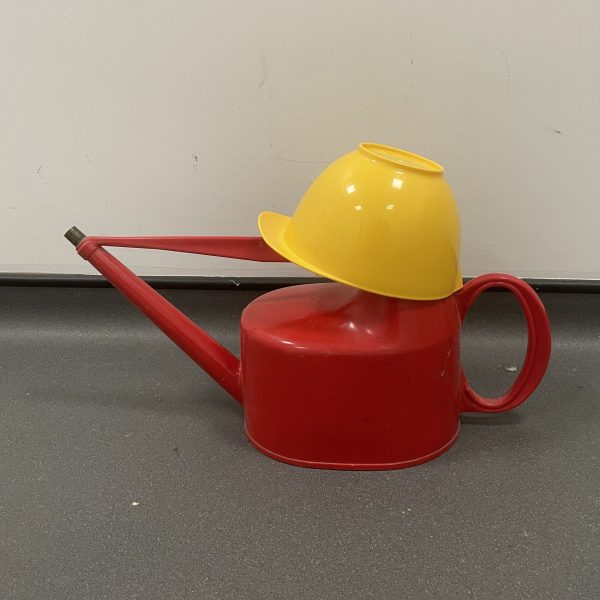
Picture 1. One of the novel objects I used in my neophobia trials. I like to think I can say with a reasonable degree of certainty that no pigeon has ever seen one of these before.
Work is certainly going to ramp up over the next few months. On top of putting everything in place for pigeon flights, we are busy providing our on-site aviary with a shiny new pond, ready for the arrival of a number of duck species over the hatching season. Shoveler, Pintail and Wigeon ducklings will be arriving throughout May and June from a certified breeder. Steve and I paid them a visit last week to see some of the parent birds, as well as their facilities, to gain inspiration for our own pond build in Oxford. If all goes to plan, we will have 60 birds in total, with more on the way next year, so this is no mean feat! The hope is that we can replicate the methods we use on pigeons with ducks. Ducks fly in quite a different manner to pigeons, and their visual fields are very different too. Their flocks are more akin to the iconic V-formations with which we are all familiar, as opposed to the clusters that pigeon flocks adopt when in flight. Hopefully I’ll have more to discuss on the duck work in my next update!
I’ll round off by mentioning that, in his visit to the field station this week, I got the chance to speak to Lord William Hague—Chancellor of the University of Oxford—about my upcoming work. A very special occasion for us at the field station and a chance to give our pigeons some of the recognition that they well and truly deserve. Well done pigeons.
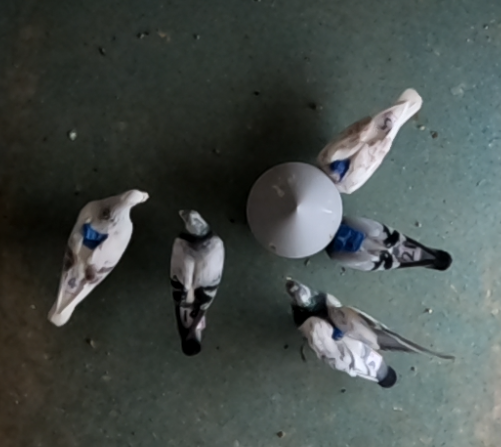
Picture 2. A still from one of my dominance trials. The round feeder has restricted access, with only three birds being able to feed from it at any one time (in a loft of 25 birds). Perhaps the two birds on the left are politely discussing whose turn it is to feed next? Often these interactions aren’t so amicable.
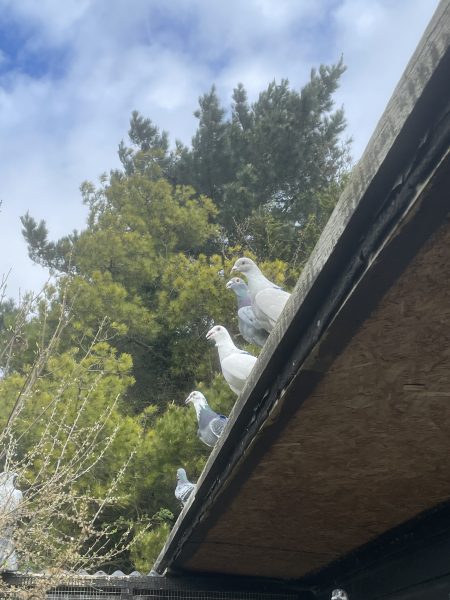
Picture 3. Some of the birds enjoying a bit of time outside on a sunny afternoon. We often open the lofts up while they’re cleaned or when we replenish the birds’ food and water.
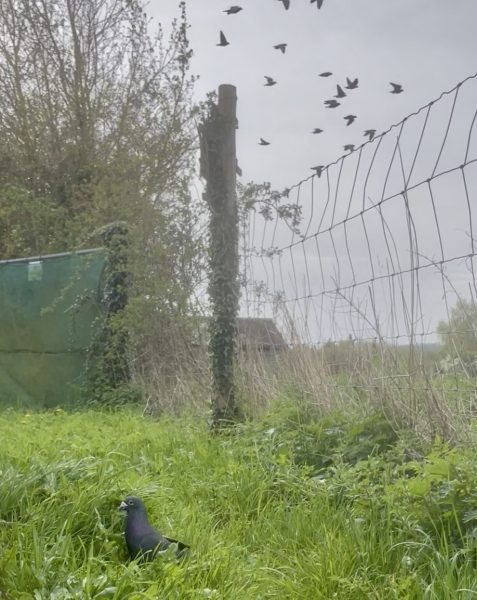
Picture 4. Cedric—one of our flightless, retired birds—going for a walk while the rest of the flock enjoy some exercise on the wing.
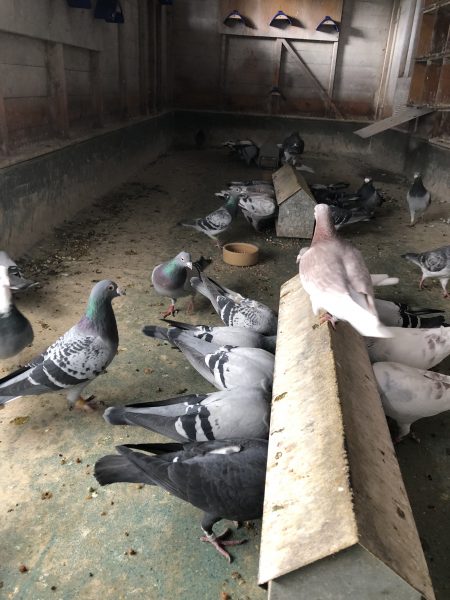
Picture 5. Lunchtime at the lofts!
_______________________________________________________________________________________
For more information about the author Sam Thompson, see his other blog here.