
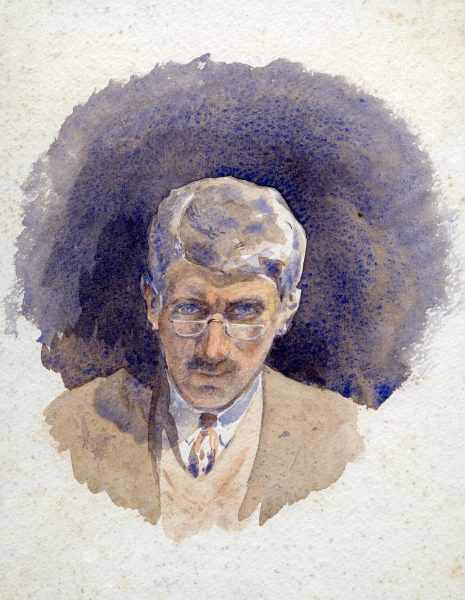
Collingwood Ingram self-portrait from the 1930s
Collingwood Ingram (1880 – 1981) was a BOC member for 80 years, a record unlikely to be beaten. He joined at the age of 20 in 1901 and remained a member until he died aged 100. His first note in the BOC Bulletin, in 1901, reported a Scops Owl in Broadstairs; the last, in the same journal in 1981, put forward his view, later to be disproved, that Magpies were responsible for the decline in the number of songbirds.
In 1842 his grandfather founded the Illustrated London News, an enormously successful newspaper that stayed in the family until 1961. Collingwood, because of childhood ill health, was educated at home by tutors and subsequently had no role in the newspaper. Instead, he led a financially independent life focusing first on ornithology and field sports, and later on horticulture and plant-collecting. Thanks especially to Naoko Abe’s best-selling 2019 book ‘Cherry’ Ingram: the Englishman who saved Japan’s blossoms, he is known worldwide as an expert on flowering cherries.
His parents took their love of birds to extreme lengths. In their homes in London and Westgate-on Sea, in Thanet (Kent), many birds flew freely and nested indoors, while others were in aviaries. This undoubtedly led to Collingwood’s childhood love of birds (although it might well have had the opposite effect!), but it was on solitary walks in and around Westgate that he got to know and sketch birds in nature. At 15 he produced a handwritten book, British Birds: nests and eggs I have found, showing that he was already a gifted observer and, incidentally, providing a valuable historical record of the birds of Thanet.
His parents also had a home in Monte Carlo and as a teenager he spent many months there, often out studying the birds of the Riviera. In 1901 he travelled to South America and in 1902 to Australia, forerunners of a life of worldwide travel. In 1905 he recorded the first known breeding of the Marsh Warbler in Kent, one of the highlights of his ornithological life. Around the same time, he began researching in the Bird Room of the Natural History Museum, conveniently near the family’s London home in Cromwell Road. Studies of skins from Australia (two districts), Manchuria and Yunnan, collected by professionals, were published between 1907 and 1912, mainly in Ibis.
A study of the birds of Japan was rather different. He was married in 1906 to Florence Maude Laing (1881 – 1979) and they spent a delayed honeymoon in Japan in 1907. H. E. Dresser suggested that he search there for the eggs of White’s Thrush, and he extended this to a much wider study, aided by Japanese collectors. The resultant paper, again in Ibis, included his observations on the breeding habits of many species. It is not recorded what Florence thought of the honeymoon.
Around 1911 he decided to extend his early studies of birds of the Riviera to include the whole of France, with the aim of publishing a major book. Each spring until the start of WW1 he travelled through France, recording birds, visiting museums and meeting French ornithologists, He was in France shortly before the outbreak of war brought these studies to a halt.
The halt was temporary because, after serving with the home-based Kent Cyclist Battalion (during which a posting at Lydd made possible a study of the birds of Dungeness), he joined the Royal Flying Corps as a Compass and Navigation Officer. In France, when not servicing the compasses on the planes, he was out with the birds again. His war diaries, full of sketches of birds, portraits of pilots and much else, were published as Wings over the Western Front in 2014
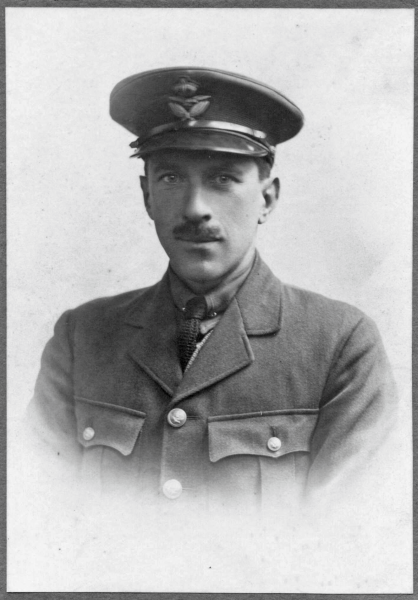
Collingwood Ingram in WWI uniform, aged about 35
After the war his interests changed, not necessarily a result of the war but more likely because of a move from Westgate to Benenden in the Weald of Kent and the acquisition of a garden. In the garden were two beautiful, mature Japanese cherry trees that captured his imagination. Birds gradually gave way to cherries and his book on the birds of France, some already in proof, was never published: just one part, Birds of the Rivera, was published in 1926. The next two decades were devoted largely to cherries, although he found time for extensive travel and published a naturalists’ travel book Isles of the Seven Seas in 1936.
In WW2 he was Commander of the Benenden Platoon of the Home Guard, typically recording its activities in two large exercise books. 1948 saw the publication of Ornamental Cherries, which remained the standard work until the end of the century.
Collingwood returned to ornithology after the war, attending successive International Ornithological Congress meetings, in Uppsala, Basle and Helsinki in the 1950s. At Basle he gave a paper on moult and at Helsinki one on camouflage in nestling birds. At these meetings, he met many of the great ornithologists of the day, including David Lack, James Fisher, David Snow and Roger Tory Peterson. He was stimulated to return to observations he made in 1919 on suspected cannibalism by nestling Short-eared Owls and published a paper on the topic in Auk in 1959. At Helsinki, Japanese ornithologists discovered that the Ingram present was the same Ingram who had published a major paper on Japanese birds fifty years earlier. He received a letter the following year inviting him to become an honorary member of the Japanese Ornithological Society.
At seventy, with eyesight and hearing on the wane, active ornithology was difficult. Instead, he wrote memoirs, one on his garden, the other, In Search of Birds (1966), which included memories of colleagues in the Bird Room and in the BOC. Even this was not the end as two small books, The Migration of the Swallow and Random Thoughts on Bird Life, followed. If he was fortunate to live a life with no need to earn money, he made full use of his good fortune, celebrating the natural world. Samples of his travel journals, with evocative writing and often with field sketches, can be seen at https://www.collingwood-cherry-ingram.com .
Author Information
Ernest Pollard – August 2026

