An interview with Ross Ahmed, author of ‘North American Landbirds in the Western Palearctic’, published by Helm, an imprint of Bloomsbury Publishing.
Ross Ahmed began birding over 32 years ago (when 11 years old) and has worked as a field ornithologist for the last 17 years. Although he enjoys the challenge of finding birds in the field, he also spends many hours sitting in front of a computer analysing numerical data in R. Lindisfarne NNR was also his study site for an MPhil on Brent Goose at Newcastle University, which he completed in 2015. He serves on the British Ornithologists’ Union Records Committee at present. First bird records include first national records of Franklin’s Gull for Kazakhstan and Black-headed Heron for Saudi Arabia.
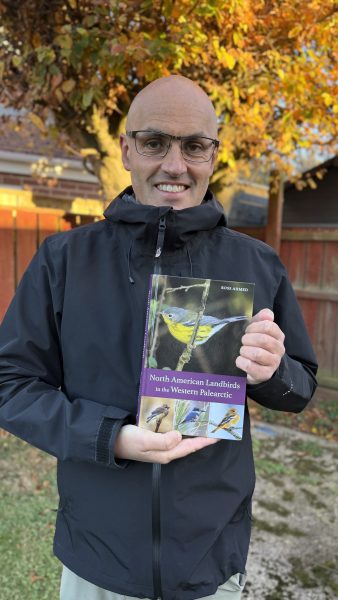
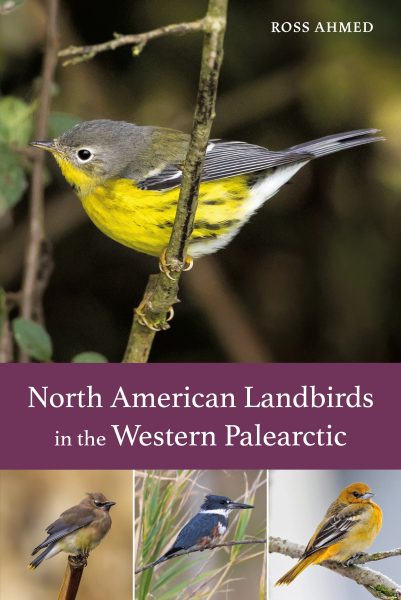
Gehan de Silva Wijeyeratne (BOC Trustee) interviews Ross Ahmed.
How did this book come about?
I initially approached Bloomsbury about doing a book on rare birds recorded in Britain, something akin to Russell Slack’s 2009 book Rare Birds Where and When. They liked the idea but also suggested an alternative idea – a book on North American landbirds in the Western Palearctic. It did not take much thought before I realised this was an excellent idea and I was aware of the interest these birds garner, plus I could use some of the fabulous photographs taken on the Azores and elsewhere. Many North American landbirds look so different to what Europeans are accustomed to, and would make for a striking book. The Azores’ rapid rise in reputation among British birders, which began in 2005 when Peter Alfrey visited Corvo (the smallest island of the Azores archipelago), makes for incredible reading.
How many years was this book in the making?
The first contact with Bloomsbury was made in autumn 2023 off the back of the best ever year for arrivals of North American landbirds on this side of the Atlantic. Interest among the birding community was high and the event even made it into mainstream media such as The Guardian. I got the go-ahead for the book in November 2023 and the bulk of it was written by about autumn 2024. Then began the long process of editing, proofreading and all of the busyness that comes with getting a book over the finish line.
What do you want to achieve with this book?
I wanted the book to be thorough, and yet readable, appealing to a wide audience of birders and ornithologists. In particular, I aimed to make the book appeal to both people in the source region of these birds – the USA and Canada – and also the destination region – Europe. I did not want the book to be simply a dry list of records. Instead, I wanted to look at the birding culture, people and sites that make the appearance of these vagrants so memorable. I do not want the project to end with the publication of the book, and I am maintaining a database of records going forward, so that an update can eventually be published, and also so the data can be used in different ways. I am happy to receive requests for others to use the data for their own projects.
One of the features I liked about your book was that you introduced the bird family to the reader. Was this a request from the publisher because some of these bird families are largely confined to the Americas?
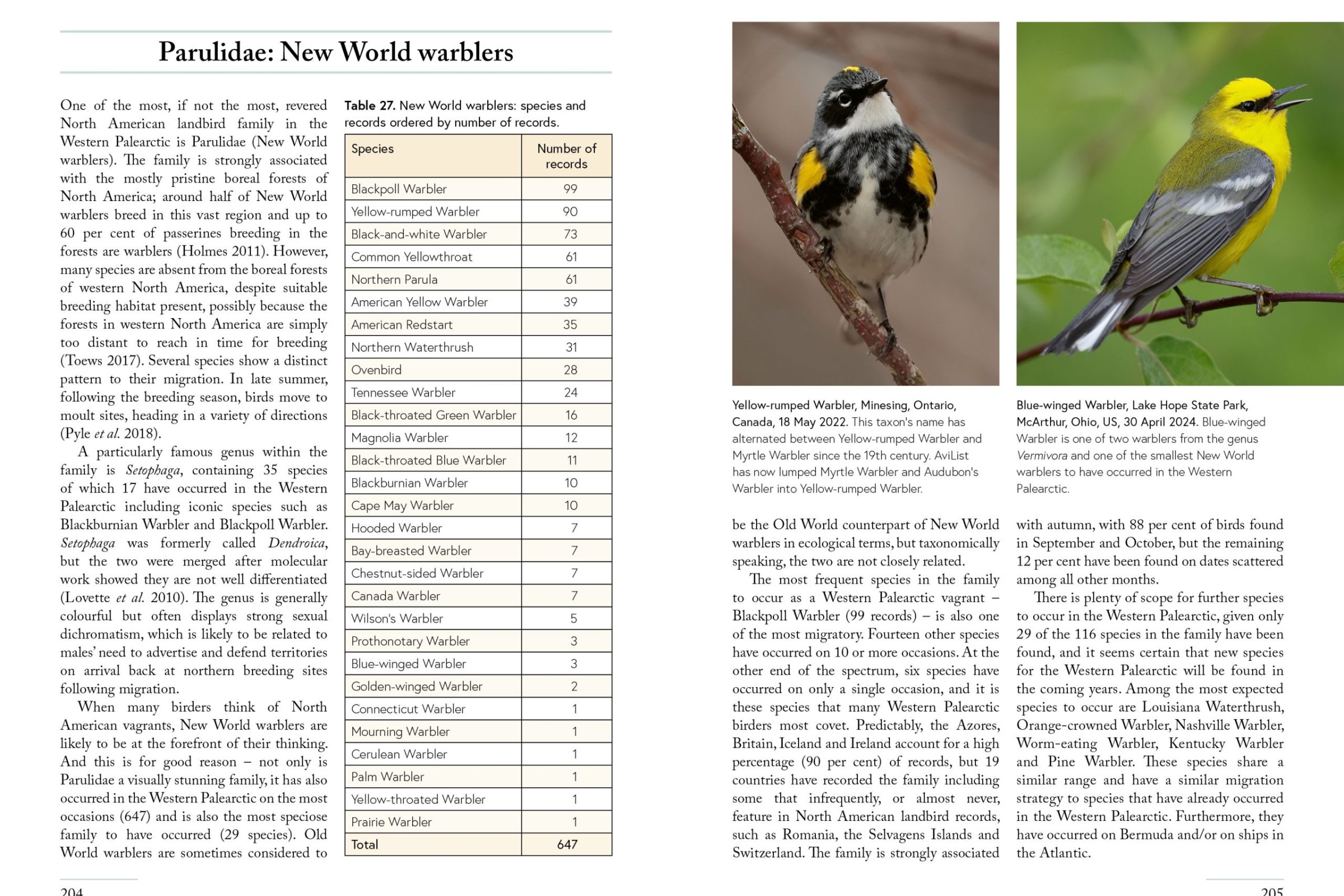
I initially suggested to Bloomsbury that a standalone section on bird families would be a useful addition to the book. This was inspired by Cornell’s Birds of the World website, which has excellent content on all of the world’s 252 bird families. Bloomsbury liked my idea, but suggested that information on each family should become part of the species accounts. Some bird families like the New World warblers are speciose, and 29 species belonging to the family have occurred in the Western Palearctic. In contrast, only 8 species of the Tyrant flycatchers have occurred, despite 448 species present in the Americas.
Is there a fun fact or something amazing you learnt during the writing of the book?
One that stands out is the first record of Baltimore Oriole for Ireland occurred at village of Baltimore in Co. Cork in October 2001. Baltimore Oriole gets its name from The Baltimores of Maryland family who governed the province of Maryland as a proprietary colony in the 17th and 18th centuries. While this is remarkable, perhaps it is actually less remarkable than it initially appears. Generally speaking, we only find what we are looking for and perhaps birders visiting Baltimore in Cork think of Baltimore Oriole and are therefore more likely to find the species there than elsewhere.
Were there any memorable moments during the course of writing this book?
It has to be the incredible autumn of 2023. For birders in Britain and elsewhere in Europe, this was exciting and memorable. For those who were lucky enough to discover one of these vagrants that autumn, the memories will last a lifetime. Unfortunately, I was not one of the lucky few, but watching the event unfold online was almost as exciting. In particular, the story of Toby Phelps, who discovered the third Magnolia Warbler for Britain followed by the first Canada Warbler for Britain three days later, will live long in the memory.
For anyone who wishes to pursue this topic more, are there any online resources you would recommend?
While this book is the first to deal specifically with vagrant North American landbirds in the Western Palearctic, there is a wealth of other information related to the topic. The journal British Birds, which is available online (https://britishbirds.co.uk), has now been running for 119 years and documents the occurrence of many species covered in my book. Keith Naylor has devoted a lifetime to storing data related to the occurrence of vagrants in Britain. He has shared his database in various formats online such as on the British Birds website (https://britishbirds.co.uk/rarities-committee/records/previous-records) and via his own website Historical Rare Birds (https://historicalrarebirds.squarespace.com/cat-ac-list). For a view from the other side of the Atlantic, the Cornell Lab of Ornithology is doing fantastic work to promote the conservation of North American landbirds and maintains several key resources such as Birds of the World (https://birdsoftheworld.org), Macaulay Library (https://www.macaulaylibrary.org) and BirdCast (https://birdcast.org). Last but not least, Partners in Flight (https://partnersinflight.org) also helps conserve North American birds through publishing Watch List Species, which is a science-based conservation assessment system.