
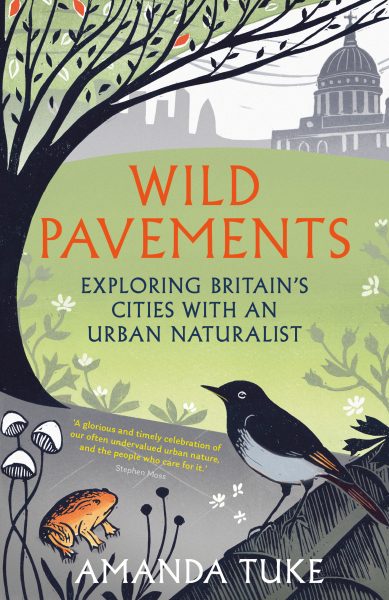
An interview with Amanda Tuke, author of ‘Wild Pavements – Exploring Britain’s Cities with an Urban Naturalist’ published by Flint Books.
Amanda Tuke is a London-based urban naturalist and nature writer. She works as a consultant botanist, leads urban plant and bird walks and teaches botany. Amanda writes a monthly column for ‘Bird Watching Magazine’ which often features urban birds and her feature writing can be seen on her blog The Urban Naturalist. You can also find her on Instagram at @suburbanwilduk and on Bluesky at @amandatuke.bsky.social. ‘Wild Pavements: Exploring Britain’s Cities with an Urban Naturalist’ is her first book.

Photo credit: Louise Rose Photography
Gehan de Silva Wijeyeratne (BOC Trustee) interviews Amanda Tuke.
This article was first published in the Quarterly Newsletter (No. 282) of the London Natural History Society.
How did this book come about?
I have been an active member of the LNHS for several years now and I often write about urban birdwatching for my column in Bird Watching Magazine. Then around four years ago I hatched the idea of writing a book about the joy of being an urban naturalist and exploring London and other cities in the UK with that perspective. The plan was to share the delights of urban nature rambling with a wide audience, seek out people who care for nature in our cities and then, as I’m an ecologist by background, explore current ideas in ecology and conservation with particular relevance for the urban species which live alongside us.
How many years was this book in the making?
I developed the proposal for Wild Pavements in late 2022 and started the research in 2023. I began by rambling from the City of London in the direction of the eight points of the compass, with a loose ultimate destination in mind in each case but not a fixed itinerary. En route I looked out for interesting pavement plants, street trees, fungi, insects and birds and so on. Between London walks I was also exploring other cities in the UK for features for my magazine column.
What do you want to achieve with this book?
There is already a legion of inspirational urban nature custodians across Britain and beyond. From them I heard repeatedly that the most effective way we can care is by paying attention to nature and learning more about it whether we’re naturalists, photographers, foragers, or just love spending time in the open air. I believe we really do need even more urban naturalists of all ages and backgrounds who recognise plants, fungi, invertebrates, amphibians, reptiles, birds and mammals and understand what these different groups need to thrive. And we need city-based naturalists, who are skilled at sharing their knowledge and passion with others, and can persuade more people to take positive action for the benefit of urban nature.
Is there a fun fact or something amazing you learnt during the writing of the book?
I’m regularly amazed by how the species I’ve found have had to adapt to cope with us, their often-challenging neighbours. Despite the noise pollution we create and inexplicably tolerate, some songbirds have found ways of keeping their communication channels open. Pavement plants survive where they aren’t repeatedly sprayed with herbicide, or in some cases, like the Rue-leaved Saxifrage, are showing signs of herbicide resistance. Urban Peregrines make use of artificial light for nocturnal hunting, and Flounder fry find sanctuary in the rubbish we dump in rivers. But there are many more species for which cities remain hostile, hazard-filled places. Toads struggle to negotiate busy roads, and migrating birds strike glass-sided office blocks. Urban Dippers breed less successfully because of water pollution, and air and light pollution reduce the diversity of insects, fungi and plants.
There are things we can all do to support urban biodiversity. We can consider the advice of wildlife gardeners and make thoughtful changes in our own gardens, accept some plants growing on pavement edges, demand wildlife-friendly street trees, champion a mosaic approach to managing our parks and cemeteries and insist that green roofs be the norm rather than the exception. A greater quantity and diversity of wild plants could mean more fungal diversity, more diversity of invertebrates and small mammals, and potentially more birds and larger mammals.
But there are also some things we might need to stop doing for the benefit of urban wildlife. Will 2026 be the year when the weight of evidence against generalised bird feeding finally stacks up? Or when we stop believing that keeping honeybees is good for biodiversity, particularly given the evidence that urban beekeeping is correlated with a fall in wild bee diversity? Or we challenge the idea that sowing ‘wildflower seed’ is the answer to increasing plant diversity? Or when we stop tolerating the levels of air, light and noise pollution our cities currently generate?
Not everyone is enthusiastic about sharing our built-up world with wild plants and animals, which was a key motivation for writing this book. The diverse human populations which make city living so gloriously rich inevitably mean diverse attitudes to the natural world. So what are the most persuasive arguments for nurturing urban nature? For starters, some of the changes which would benefit nature would be great for us too. I’m guessing that only a minority of city-dwellers would object to less dumped rubbish and dog mess, more thoughtful building projects, more street trees, or aspirations to reduce noise, water, air, and light pollution. Persuading residents to tolerate more plants on pavements, wilder-looking verges, estate lawns, parks and cemeteries, and more wooded parks might be a harder sell, but progress is being made in some areas, and learning can be shared. Managers of our city grasslands are discovering that understanding different perspectives, effective communication and directly involving residents are essential to bringing communities on board. Using ‘cues to care’, is another approach. For example, imagine in an urban park an area of grassland is deliberately allowed to run wild each year to encourage wild flowers and invertebrates. A thin border can be mown around it to show that the mowing approach is considered, rather than lazy. This can help change perspectives and educate people that an urban park is being managed to foster biodiversity.
Were there any memorable moments during the course of writing this book?
There are really too many delightful moments and amazing people to mention, but the real standouts for me were the male Black Redstart I found just off Oxford Street, the Common Toads I helped on their perilous journey to a pond in a London park, the partnership protecting nesting Kittiwakes on the Tyne Bridge in Newcastle, and meeting the inspirational street tree activists in Sheffield.
For anyone who wishes to pursue this topic more, are there any online resources you would recommend?
The Natural History Museum has set up a free-to-join Urban Nature Network and has produced a couple of excellent beginner-friendly guides to urban plants which you can download for free. https://www.nhm.ac.uk/take-part/identify-nature/pavement-plants-id-guide.html

