
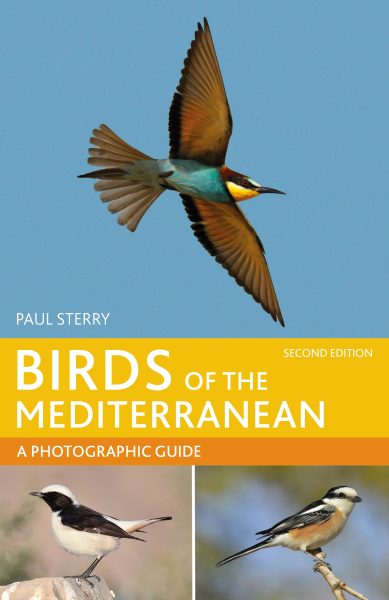
An interview with Paul Sterry on Birds of the Mediterranean: A Photographic Guide, Second Edition, published in the Helm series by Bloomsbury Publishing.
Paul Sterry is a wildlife author, photographer and conservationist. He has written and illustrated more than 50 titles on a wide range of natural history subjects, and founded the international competition Bird Photographer of the Year. Nowadays, in addition to writing and travelling, and fighting for the natural world, Paul is a trustee of the conservation charity Birds on the Brink, which he founded alongside fellow trustee Andrew Cleave.

Gehan de Silva Wijeyeratne (BOC Trustee) interviews Paul Sterry.
What sparked your interest in Mediterranean birds?
I can trace the origins of my interest in the subject to a trip to Mallorca nearly 50 years ago. Subsequent visits to other destinations around the region further whetted my appetite for the Mediterranean’s avian fauna. From a photographic perspective, it was a trip (the first of many) to the Greek island of Lesvos in the 1990s that laid the groundwork for what was to become a passion – photographing the birds of the Mediterranean.
What are the origins of this book?
In the early 2000s, I was commissioned by Nigel Redman to write and illustrate photographically the 1st edition of ‘Birds of the Mediterranean’, which was published in 2004 by Christopher Helm, an imprint at the time of A&C Black Publishers. The timing of production coincided with the dying days of film and it was on the cusp of the digital era. As a result, the vast majority of the images in the book are scanned slides, with just a handful of photographs taken on first-generation DSLR cameras.
At the time of its publication, I was happy with the printed 1st edition of the book. However, looking at it with a critical eye two decades on, there is clearly room for improvement now that digital imagery has matured. Fortunately, Jim Martin from Bloomsbury Publishing shared this opinion, and suggested a revamped 2nd edition, which was published under the imprint Helm.
How many years was this book in the making?
In some senses, the 2nd edition of Birds of the Mediterranean represents an entire adult lifetime of interest in the subject. However, from a photographic perspective, it was the last two decades that were crucial in the quest to capture the digital images that populate the book with a level of detail that could only have been dreamt of in the days of film.
What do you want to achieve with this book?
Birds of the Mediterranean is very much an introduction to a complex subject. The book is aimed at birdwatchers embarking on their individual birding journeys, literally and figuratively. It is informative and portable. More than that, if it inspires and encourages people to become passionate about Mediterranean birds and their conservation it will have done its job.
Did you have any unusual or humorous experiences while working on the book?
Many years ago, I spent a couple of weeks in southern Turkey photographing, amongst other things, wetland birds. For this, I used a portable photographic hide, which I erected and entered each day before dawn. I would emerge again mid-morning, pack up my equipment and hide, and walk back to where I was staying. On my return journey, I was invariably the subject to quizzical stares and muttered comments from the locals. For the life of me I couldn’t figure out why, until one day a Turkish friend made some enquiries on my behalf. It turned out that the local rumour-mill had concluded that I was a shy Englishman who, embarrassed by performing his ablutions in public, had brought with him a private toilet tent. The local bewilderment stemmed not from the notion of a private toilet tent, but from my need to stay in it for hours on end.
Were there any memorable moments during the course of writing this book?
For me, the memorable moments associated with this book are linked to photography rather than its writing. If I had to single out one occasion, I would return to my first visit to Lesvos in the 1990s. Following torrential rain and thunderstorms the night of my arrival, I ventured out at dawn uncertain about what to expect. In the first hour or so of light, and before breakfast, I had seen nudging 100 Red-backed Shrikes and an array of other grounded migrants. As the day warmed up, Black-headed Buntings and Cretzschmar’s Buntings vied for photographic attention; passing groups of White-winged Terns, Bee-eaters and Red-footed Falcons kept up the momentum; and a Great Snipe displaying right beside my car was a completely unexpected bonus. Unsurprisingly, I was hooked.
For anyone who wishes to pursue this topic more, are there any online resources you would recommend?
You can use the online resource eBird to find out much more about birds of the Mediterranean region, record your sightings and keep an online list of what you have seen.
For detailed information about Mediterranean bird species (and indeed all the world’s birds), including population trends and maps, visit the Birdlife International website. The organisation has active partner organisations in most countries that border the region.
These days, if you visit the Mediterranean for its birdlife, you cannot ignore the conservation problems that beset the region. Specifically, the killing of migrant birds for ‘fun’ masquerading as tradition. I would urge all birdwatching visitors to support the Committee Against Bird Slaughter (CABS), which valiantly confronts the wretched practice in locations including Malta and Cyprus. I would urge birdwatchers to boycott those islands in particular, unless you are intending to provide support for CABS.

